4: Mindfulness of Wisdom and Compassion

“All things arise when the appropriate conditions are present, and all things pass away as conditions change. Behind the process, there is no “self” who is running the show” Joseph Goldstein
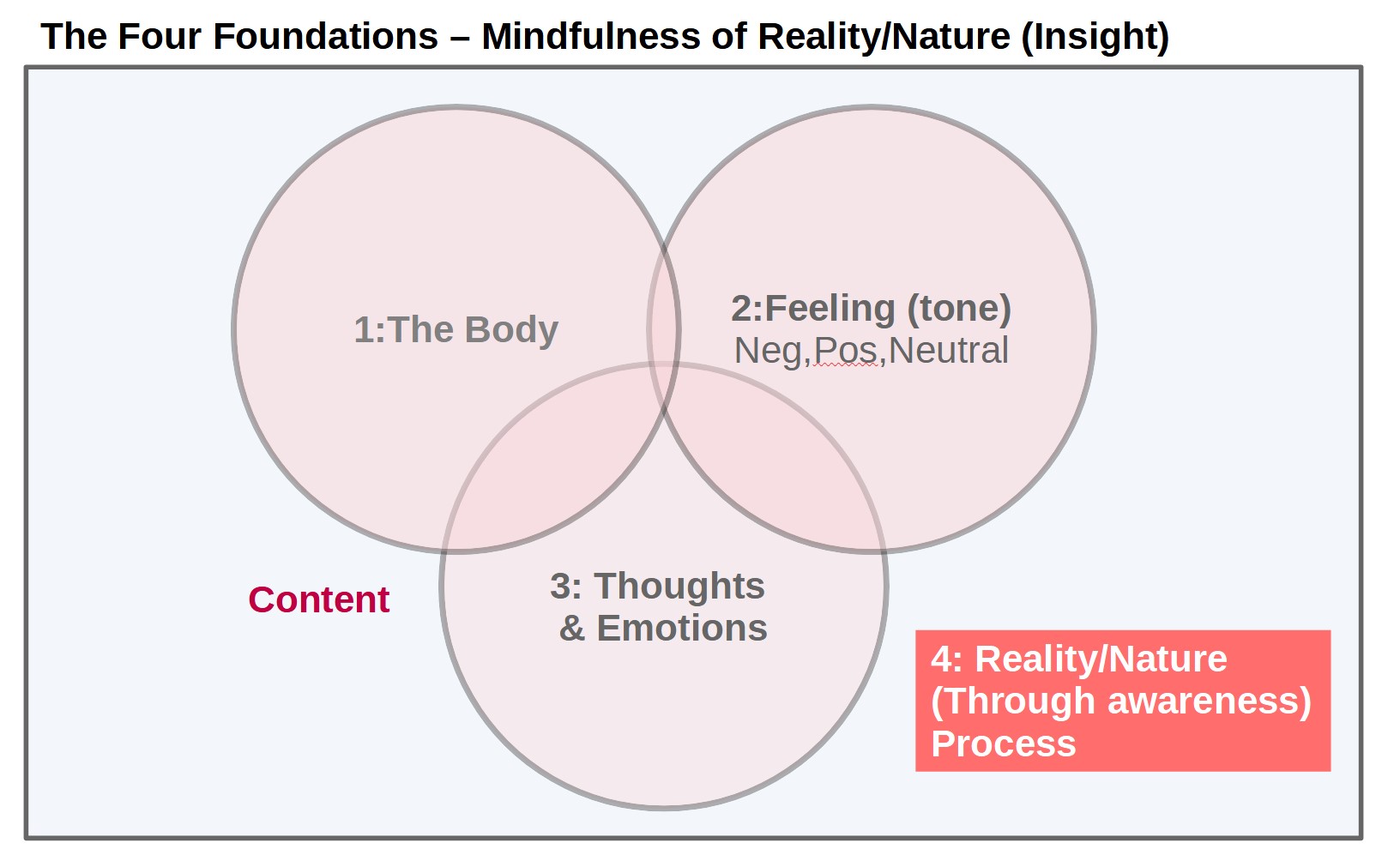
Mindful investigation (of reality) – the fourth Foundation
All the foundations are open to a degree of interpretation. The fourth one especially so. Buddhism uses the words Mindfulness of Dhamma (Pali) The word Dhamma itself has two meanings. 1) the ultimate nature of reality and 2) the teachings and explanations of the Buddha.
So from a Buddhist perspective the fourth foundation is about developing a personal understanding and knowledge of the “reality” of nature. Through an understanding practice of the teachings. This is often referred to as “insight”. It comes about through personal investigation of the experience of living.
The Buddha boiled this down into, what are called the three “noble truths” about the “nature” of reality as we experience it.
1: There is nothing that will permanently satisfy us or make us permanently happy (Dukkha)
2: Nothing lasts forever – it’s all changing all the time (Anicca)
3: When you look really closely you cannot find a permanent self (Anatta)
He famously adds that no one should take his word for this. That it’s up to each of us to test this hypothesis for ourselves.
How do I practice with this foundation?
The emphasis here is on investigation and reflection. Whilst we are undertaking our mindfulness practices and, of course, in everyday life we can simultaneously notice the recurring qualities of our experience. Through this ongoing investigation and reflection we can come to KNOW rather that just theoretically or conceptually appreciate these qualities.
For example we might notice over and over again that we tend to grasp at things that we believe will make us happy, like a new phone, only to find it eventually becomes outdated and that we become dissatisfied – again. We might really invest ourselves in a partner only to find that that they leave us or worse still die before we do. Is there any condition that will permanently satisfy us? – or is there always a sense of dissatisfaction (Dukkha) that returns again and again in small and big ways?
The reality of impermanence (Anicca) is perhaps the easiest to understand. We all realise the life will end, buildings will fall and the sun will burn up .. one day. But this impermanence pervades everything .. from thoughts to mountains. How does it help to really KNOW this in your bones? How would we behave differently?
The quality of non self (Anatta) is the most controversial and misunderstood contention. I does not mean you do not exist. Clearly each of us has a body, a personality and history. Rather we might take notice of how tightly we hold onto a sense of who I am and what I possess and whether this leads to a happy outcomes. How engaged are we in “selfing” .. boosting our ego through possessions or feelings of entitlement, for example?
The invitation is to investigate whether living “in tune” with this “bigger” reality brings us more peace and deeper happiness than continuing with more conventional wisdoms propagated by our old brains and, say, the advertising industry.
“I have no special talents. I am only passionately curious.” –
What is awareness?
Dr. David Cox of the National Health Service likes to use a simple analogy to explain awareness versus non-awareness. “Imagine watching a horror movie alone, at home, with the lights off,” he says. “The movie owns you. It’s terrifying. It’s all you’re aware of and so it has complete control over your emotions.” Similarly, when you’re experiencing thoughts in a state of non-awareness, they can be scary and all-consuming.
In contrast, awareness is like watching that same scary movie by yourself, but this time with the lights on. “With the lights on, you have more context,” explains Dr. Cox. You can see that the movie is in fact just a movie playing on TV, and that there are other things around you like your dog and your favourite pillow. “It’s still scary, but it’s not as bad as it is with the lights off because you have a bit more perspective.”
Another fancy word for this is Metacognition. That is an awareness and understanding of one’s own thought processes – as they happen.
“By practicing awareness — not identifying with what we think, what we feel, what we believe, or what we know — we get to create a spaciousness of mind that sets us free from the impact of our thoughts and feelings; it allows us to be more at ease with the moment-to-moment unfolding of life itself” Andy Puddicombe
Connection, compassion and kindness

“If we try to practice meditation without the foundation of goodwill to ourselves and others, it is like trying to row across a river without first untying the boat; our efforts, no matter how strenuous, will not bear fruit” Joseph Goldstein
One definition of compassion offered by Christina Feldman and Willem Kuyken (Paper below)
“Compassion is an orientation of mind that recognises pain and the universality of pain in human experience and the capacity to meet that pain with kindness, empathy, equanimity and patience. While self-compassion orients to our own experience, compassion extends this orientation to others’ experience.”
Why is cultivating compassion (for ourselves and others) important?
The work or practice of mindfulness can be seen as gradually gaining greater insight into our minds. How our minds work and how they do and don’t impede our sense of wellbeing. One could say it is a path leading towards greater wisdom, peace and balance. This is both in the intellectual sense but more importantly the deeper level of truly knowing through direct experience.
On this journey in mindfulness we work with the material we have at hand. Our minds and are bodies as they are with all their beauty and imperfections. One propensity of the mind is to judge and criticise both ourselves and those around us. This is hardly a revelation to most of us. We all to some degree and and different times experience self-criticism and hot, often ill informed, judgements of others.
One can see, and you will have experienced, how opening up honestly to our experience, thoughts and feelings can be derailed by this propensity of the mind to be critical and judgemental. It actually gets in the way of our progress towards self-understanding. It can be a serious hindrance. The hold self criticism has over some of us is sometimes displayed as serious discomfort when working with these practices.
Fortunately it is possible to counter this tendency by deliberately cultivating qualities of connection, compassion and self-acceptance. In Buddhist parlance these are described as Metta practices. In mindfulness they are often called loving-kindness or compassion practices.
The good news is that not only do these practices aid us in developing insight they are hugely beneficial on their own terms. There is now considerable (see paper below) evidence that compassion practices can be beneficial to all of us but especially to people who experience self criticism to a debilitating degree. e.g: people with depression.
Practices & Investigation
- FORMAL: Find time to do the Mindful Questioning Practice and the Mindful Connection Practice a few times this week.
- Use the practices you have learned to build up your own daily formal practice .. at least 12 minutes per day
- INFORMAL: Continue to bring mindfulness to everyday activities whenever you can
- Seek our opportunities to practise with others and learn more (Bob’s free practice sessions!)
Mindful Questioning (20mins)
Connection with kindness – short (11 mins)
Connection with kindness – long (20mins)
Reading and resources
- Compassion in the landscape of suffering_CB_FeldmanKuyken_2011
- Chronic pain is surprisingly treatable Oct 2021
Deeper Mindfulness – Prof Mark Williams
I recommend this book which explains the central role of “Vedana” (Feeling tone) in mindfulness practice.