
Week 1 – The Foundations of Mindfulness
A framework for exploration
“The Four Foundations of Mindfulness” were articulated 2500 years ago in one of the Buddha’s seminal texts on mindfulness: the Satipatthana Sutta. They are applicable to all of us whether we are interested in Buddhism or not as they are a deep investigation of the human mind” from Breathworks
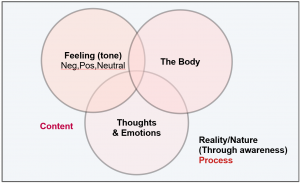
The four foundations are a framework and set of instructions for investigating particular aspects of human experience. No beliefs are required to use this framework it is available to anyone and underpins modern secular mindfulness.
Aspects of this ancient framework are being explored by modern psychologists, neuroscientists and cognitive scientists. How it works to sustain better mental health is gradually being unpacked and better understood.
- Mindfulness of FEELINGS (Vedana) and our reaction to them
- Mindfulness of the BODY and senses
- Mindfulness of MIND/THOUGHTS (including emotions)
- Mindfulness of REALITY/NATURE (exploring the nature of reality)
This Course
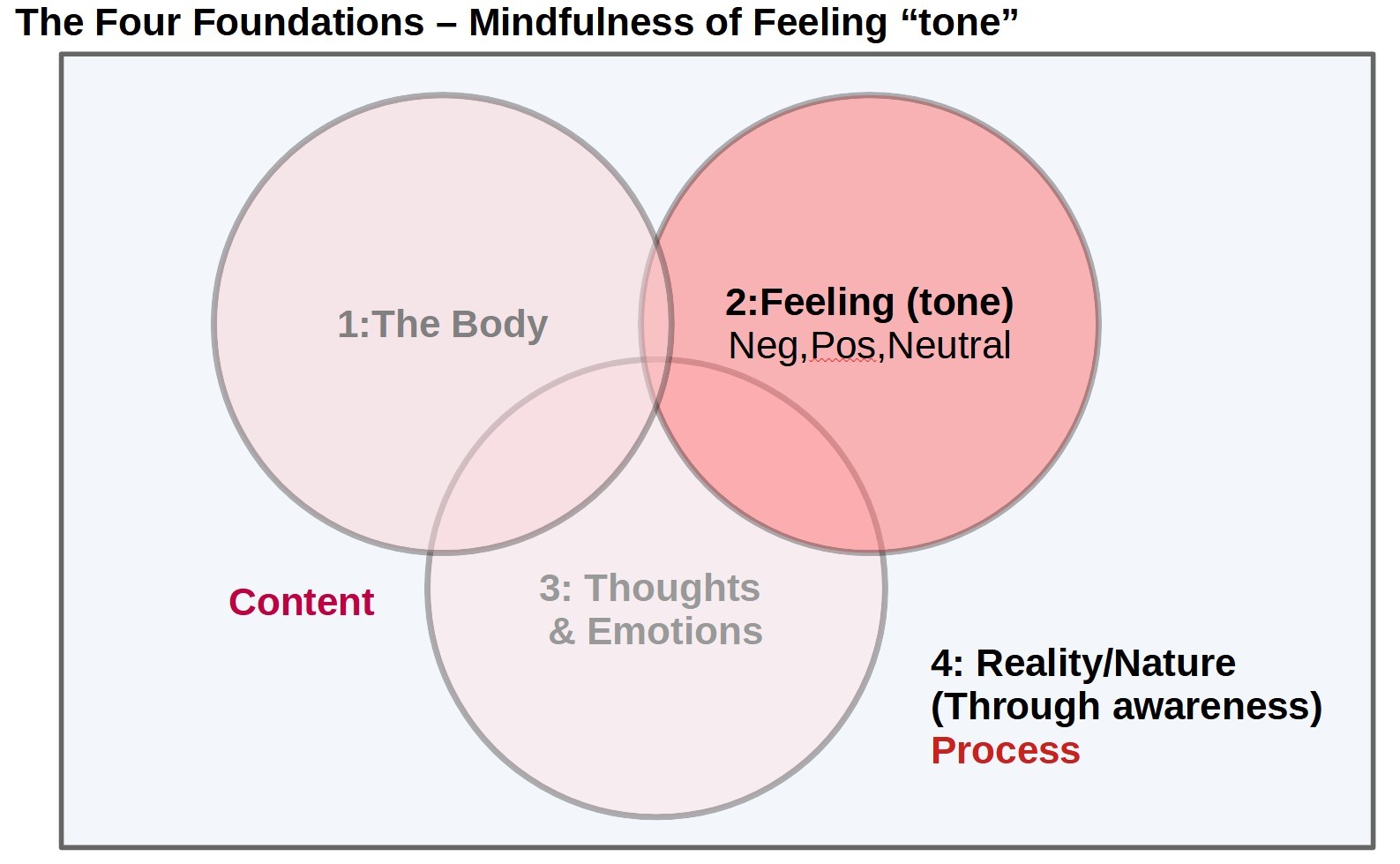
Traditionally the order is: Body, Feeling, Mind and Wisdom. In this course we will be looking at Feelings/Vedana first. This is because Mindfulness of Feelings is an important approach we can use in all the other foundations.
‘Mindfulness of feeling tone is one of the master keys that both reveals and unlocks the deepest patterns of our conditioning.’ Prof Mark Williams
Mindfulness of Feeling Tone (Vedana)
What do you mean – feelings?
“There is no satisfactory translation of the ancient Sanskrit word vedana. It is a quality of awareness that can only be experienced, not pinned down with precision. It is the feeling, almost a background ‘colour’, that tinges our experience of the world – of mindfulness itself. For this reason, vedana is often translated as feeling tone.
Although we will use both terms interchangeably, it will always pay to remember that we are referring to a flavour of awareness, and not a rigid concept that can be hedged in by words and definitions. Feeling tone is something that you feel in mind, body and ‘spirit’, but it’s true quality will always remain slightly ineffable. Sometimes annoyingly so” Prof Mark Williams – Deeper Mindfulness
We use the word feelings or feeling to describe a variety of things. Most often it is used interchangeably with emotion, as in, I feel sad or I feel happy. It is also used in relation to sensations, as in, I feel cold or I feel itchy.
The “feeling” foundation of mindfulness is referring to something a little bit different. It is referring to our immediate REACTION to an experience or sensation. It asks us pay close attention and note whether it “feels” pleasant, unpleasant or neutral. These are sometimes referred to as the “feeling tone”
It precedes thought and thinking about the experience or even our emotional reaction.
So as an example: I might bite into a cake and note that the taste has a “pleasant” feeling. On my next bite I might discover a hard cherry stone and note that was “unpleasant” Most of the time it is neither one or the other .. just neutral.
When one looks closely.. these reactions are happening all the time. Not just when we eat something.. but when we have a memory or a thought too.
The invitation is to notice just how frequently and how instantly we decide whether we like or dislike something and just how un-aware we are of this going on – almost ALL THE TIME and what the outcome of that reaction is. It happens across all our senses and our thoughts/emotions. For example:
- If we have backache we probably DISLIKE the discomfort
- If we hear music we like we may LIKE the emotions and thought it stimulates
- We may experience the sensation of wearing clothing a NEUTRAL
- We may DISLIKE having a painful memory
- We may DISLIKE the opinion someone is expressing
Why bring mindfulness to feeling tones?
Most often we are not aware of this discriminating process. It all happens so quickly and often, it seems, outside of our awareness. To attain this speed of processing our mind falls back on habitual interpretations and reactions. Learned behaviours and opinions that have been embedded during our experience of life.
The outcomes from this process may be what we want and expect .. but often they are not. If we are interested in understanding “what is going on” and opening up the possibility of responding instead of reacting then paying attention to this process can be of enormous benefit.
Developing this foundation is not about censoring your reactions or trying to change them in any way – rather it is about acknowledging what is actually happening. Just as it is – not as you would like it to be.
As you become more familiar with the pattern of reactions you will probably begin noticing what the outcomes from the reaction are and perhaps what the origins of the automatic reaction might be.
For example we might note that there is an (very) unpleasant feeling tone when somebody criticises us. Maybe we get disproportionality angry and strike out at them. We might remember that this is a pattern.
Equally so we might note there is really pleasant feeling tone when we eat some ice cream. Maybe we notice that we over-eat ice cream when we are feeling low. We are noting what the outcome is and what are subsequent reactions are. Maybe disgust with ourselves or self criticism.
In our practice we watch these feeling tones arise and change without getting “caught up” in them. We slow things down to see how they operate. Learning to see them in this way gives us a chance to make a choice – to respond – rather than to react.
It is important not to see this as a task of will power. Simply by seeing the process, change can begin to happen. Dr Judson Brewer in his book “Unwinding Anxiety” describes how it is important to fully experience unhelpful reactions and habits to the extent that one becomes “disenchanted” with them. The alternative “wiser” option simply becomes more attractive over time.
Extract from “Deeper Mindfulness” Prof Mark Williams 2023
“Learning to sense the feeling tone (Vedana) – bringing it into the light – teaches you to recognise your underlying state of mind …. it gives you the space to respond rather than react.
It helps you to compassionately accept that although you might be anxious, stressed, angry or depressed in this moment, this is not the totality of your life with only one depressing future ahead of you.
You can change course. Alternative futures are available to you. And tapping into an alternative future is as simple as sensing the underlying flow of feeling tones. Noticing the reactivity pulses. Realising that the craving for things to be different is the problem. Craving an end to unpleasantness. Craving for pleasantness to remain. Craving an end to boredom.
This idea is common to many ancient traditions. And now, neuroscience agrees”
Video – Mindfulness and Feeling Tone (58mins)
Homework
Formal: Find time to practise a sitting meditation every day (if possible). Using the Mindfulness of Feelings Audio Guide at least 3 times this week.
Informal: Bring your attention to your “Feeling tone/reactions” whenever you can. Use the labels LIKE, DISLIKE and NEUTRAL or PLEASANT, UNPLEASANT, NEUTRAL. Notice how the feeling tone influences your sensations, thought, emotions, actions and decisions. Do your best not to judge your judging – just be curious.